
DiseasyImmunity optimisation
Source:vignettes/articles/diseasy-immunity-optimisation.Rmd
diseasy-immunity-optimisation.Rmd
library(diseasy)
#> Loading required package: diseasystore
#>
#> Attaching package: 'diseasy'
#> The following object is masked from 'package:diseasystore':
#>
#>     diseasyoption
im <- DiseasyImmunity$new()Motivation
From our testing, we have learned that our method used to express the waning immunity in a compartmental model1 is a hard optimisation problem. Depending on the choice of optimisation algorithm, the quality of the approximation will vary wildly as well as the time it takes for the algorithm to converge.
To mitigate this issue, we investigate the effect of several optimisation algorithms to identify the best performing one, evaluating both run time and approximation accuracy of the waning immunity target.
?DiseasyImmunity can internally employ the optimisation
algorithms of stats, nloptr and
optimx::optimr(), which means that we have around 30
different algorithms to test.
Note that the nature of the optimisation problem also changes
dependent on the method used to approximate (i.e. “free_delta”,
“free_gamma”, “all_free” - see ?DiseasyImmunity
documentation), which means that the algorithm that performs well for
one method will not necessarily perform well on the other methods.
Setup
Since we are searching for a “general” best choice of optimisation algorithm, we will define a setup that tests a wide range of waning immunity targets.
We define a “family” of functions to test the optimisation algorithms against. These start at 1 and go to 0 within a time scale, .
These targets are:
| Function | Functional form |
|---|---|
| Exponential | |
| Sigmoidal | |
| Sum of exponentials |
We then construct more target functions from this family of functions:
- The unaltered functions ()
- The functions but with non-zero asymptote ()
- The functions but with longer time scales ()
The optimisation
As stated above, the optimisation algorithms vary wildly in the time it takes to complete the optimisation. To conduct this test in a reasonable time frame (and to determine algorithms that are reasonably efficient), we setup a testing schema consisting of a number of “rounds” where we incrementally increase the number of compartments in the problem (and thereby the number of degrees of freedom to optimise).
In addition, we allocate a time limit to each algorithm in each
round. If the execution time exceeds this time limit, the algorithm is
“eliminated” and no more computation is done for that algorithm.
Furthermore, if the value (error) of the objective function for the
optimiser is equal or greater than 1e3 it is also
“eliminated”. Note that this is done on per-method basis as we know the
optimisation algorithms fare differently for the different methods for
approximation.
Once the round is complete, we update the list of eliminated algorithms and then we run the optimisation of with the reduced set of algorithms.
The entire optimisation process is run both without penalty
(monotonous = 0 and individual_level = 0) and
with a penalty (monotonous = 1 and
individual_level = 1), see
vignette("diseasy-immunity") for monotonous
and individual_level definitions.
The results of the optimisation round are stored in the
?diseasy_immunity_optimiser_results data-set.
results <- diseasy_immunity_optimiser_results

results
#> # A tibble: 20,816 × 10
#>    target  variation          method strategy penalty     M value execution_time
#>    <chr>   <chr>              <chr>  <chr>    <lgl>   <int> <dbl>          <dbl>
#>  1 exp_sum Base               all_f… combina… FALSE       2 0.420          0.847
#>  2 exp_sum Base               all_f… naive    FALSE       2 0.420          0.715
#>  3 exp_sum Base               all_f… recursi… FALSE       2 0.420          0.651
#>  4 exp_sum Base               free_… naive    FALSE       2 0.420          0.671
#>  5 exp_sum Base               free_… recursi… FALSE       2 0.420          0.702
#>  6 exp_sum Non-zero asymptote all_f… combina… FALSE       2 0.336          0.875
#>  7 exp_sum Non-zero asymptote all_f… naive    FALSE       2 0.336          0.665
#>  8 exp_sum Non-zero asymptote all_f… recursi… FALSE       2 0.336          0.695
#>  9 exp_sum Non-zero asymptote free_… naive    FALSE       2 0.336          0.671
#> 10 exp_sum Non-zero asymptote free_… recursi… FALSE       2 0.336          0.662
#> # ℹ 20,806 more rows
#> # ℹ 2 more variables: optim_method <chr>, target_label <chr>
Global results
To get an overview of the best performing optimisers, we present an aggregated view of the results in the table below. Here we present the top 5 “best” optimiser/strategy combination for each method and penalty setting. To define what it means to be the “best” we simply take the total integral difference between the approximation and the target function across all target functions and problem sizes ().
In addition, we only consider problems up to size for the general results.
| penalty |
free_delta
|
free_gamma
|
all_free
|
||||||
|---|---|---|---|---|---|---|---|---|---|
| strategy | optimiser | value | strategy | optimiser | value | strategy | optimiser | value | |
| no | recursive | auglag_slsqp | 14.46 | recursive | subplex | 11.62 | naive | auglag_slsqp | 10.41 |
| no | recursive | bfgs | 14.46 | recursive | neldermead | 12.12 | naive | slsqp | 10.41 |
| no | recursive | bobyqa | 14.46 | naive | uobyqa | 12.15 | naive | tnewton | 10.41 |
| no | recursive | ccsaq | 14.46 | recursive | nmkb | 12.19 | naive | ucminf | 10.41 |
| no | recursive | cg | 14.46 | naive | lbfgs | 12.46 | naive | uobyqa | 10.41 |
| yes | naive | auglag_slsqp | 15.80 | recursive | hjkb | 13.84 | combination | neldermead | 11.51 |
| yes | recursive | auglag_slsqp | 15.80 | naive | hjkb | 14.00 | naive | anms | 11.62 |
| yes | naive | bfgs | 15.80 | recursive | neldermead | 14.41 | combination | anms | 11.63 |
| yes | recursive | bfgs | 15.80 | naive | pracmanm | 14.70 | combination | slsqp | 11.63 |
| yes | recursive | ccsaq | 15.80 | naive | bfgs | 14.86 | naive | ucminf | 11.63 |
| auglag_lbfgs: auglag with SLSQP as local solver. | |||||||||
To better choose the default optimisers for
DiseasyImmunity, we will also consider how fast the
different optimisation methods are. For that purpose, we have also
measured the time to run the optimisation for each problem.
# Define the defaults for DiseasyImmunity
chosen_defaults <- tibble::tibble(
  "method" = character(0),
  "penalty" = character(0),
  "strategy" = character(0),
  "optim_method" = character(0)
) |>
  tibble::add_row(
    "method" = "free_delta", "penalty" = "no",
    "strategy" = "naive",
    "optim_method" = "ucminf"
  ) |>
  tibble::add_row(
    "method" = "free_delta", "penalty" = "yes",
    "strategy" = "naive",
    "optim_method" = "ucminf"
  ) |>
  tibble::add_row(
    "method" = "free_gamma", "penalty" = "no",
    "strategy" = "naive",
    "optim_method" = "subplex"
  ) |>
  tibble::add_row(
    "method" = "free_gamma", "penalty" = "yes",
    "strategy" = "naive",
    "optim_method" = "hjkb"
  ) |>
  tibble::add_row(
    "method" = "all_free", "penalty" = "no",
    "strategy" = "naive",
    "optim_method" = "ucminf"
  ) |>
  tibble::add_row(
    "method" = "all_free", "penalty" = "yes",
    "strategy" = "naive",
    "optim_method" = "ucminf"
  )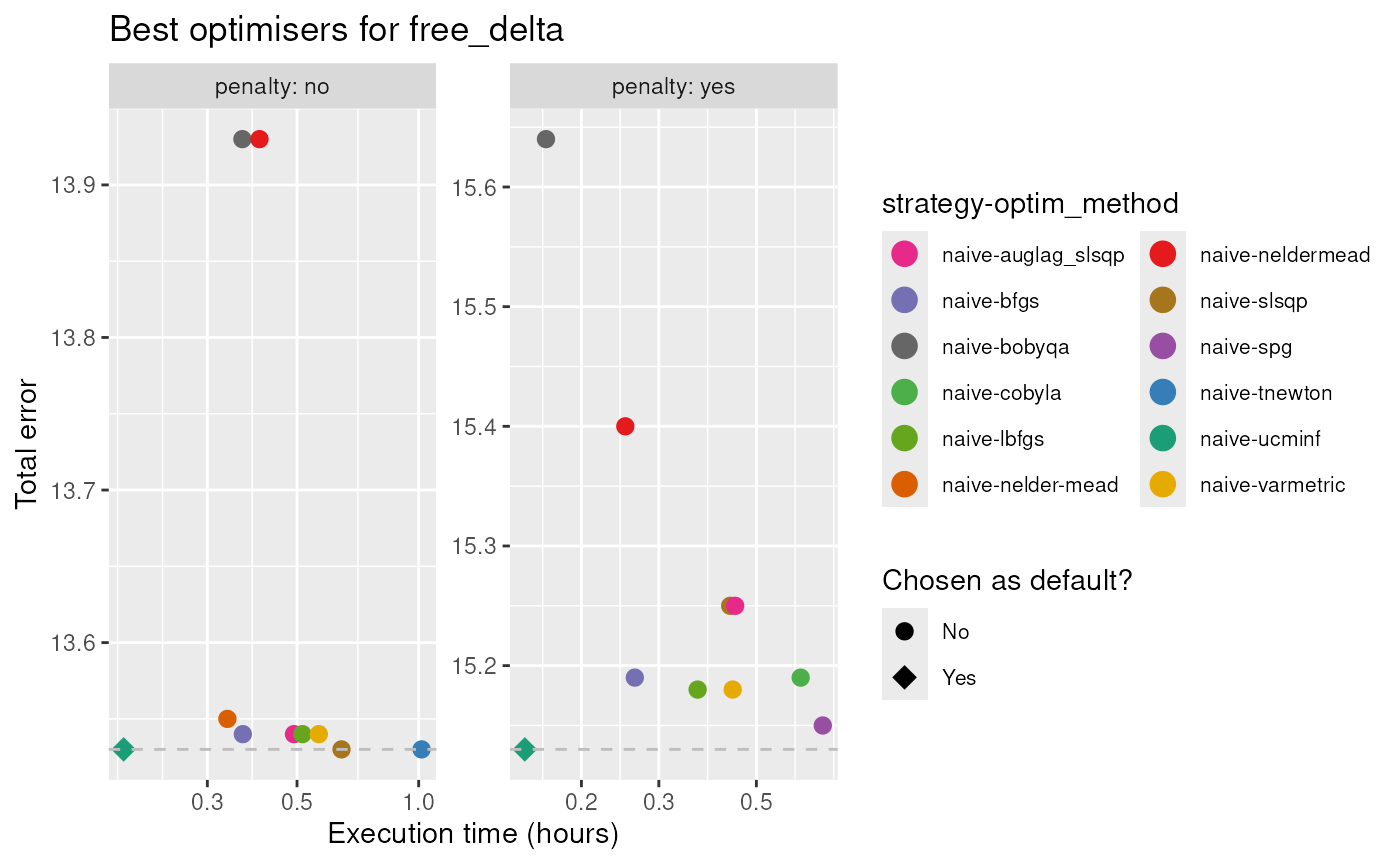
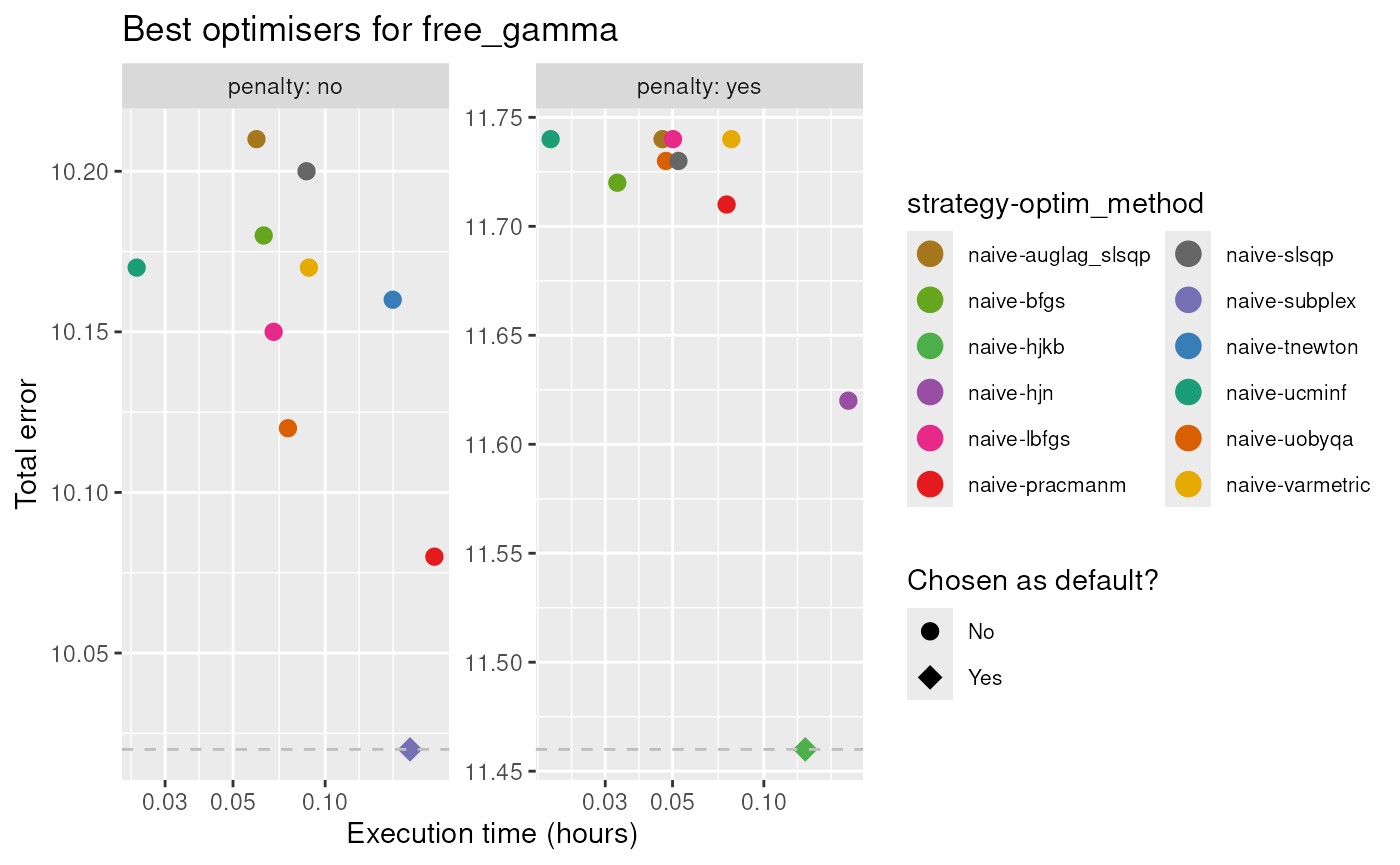
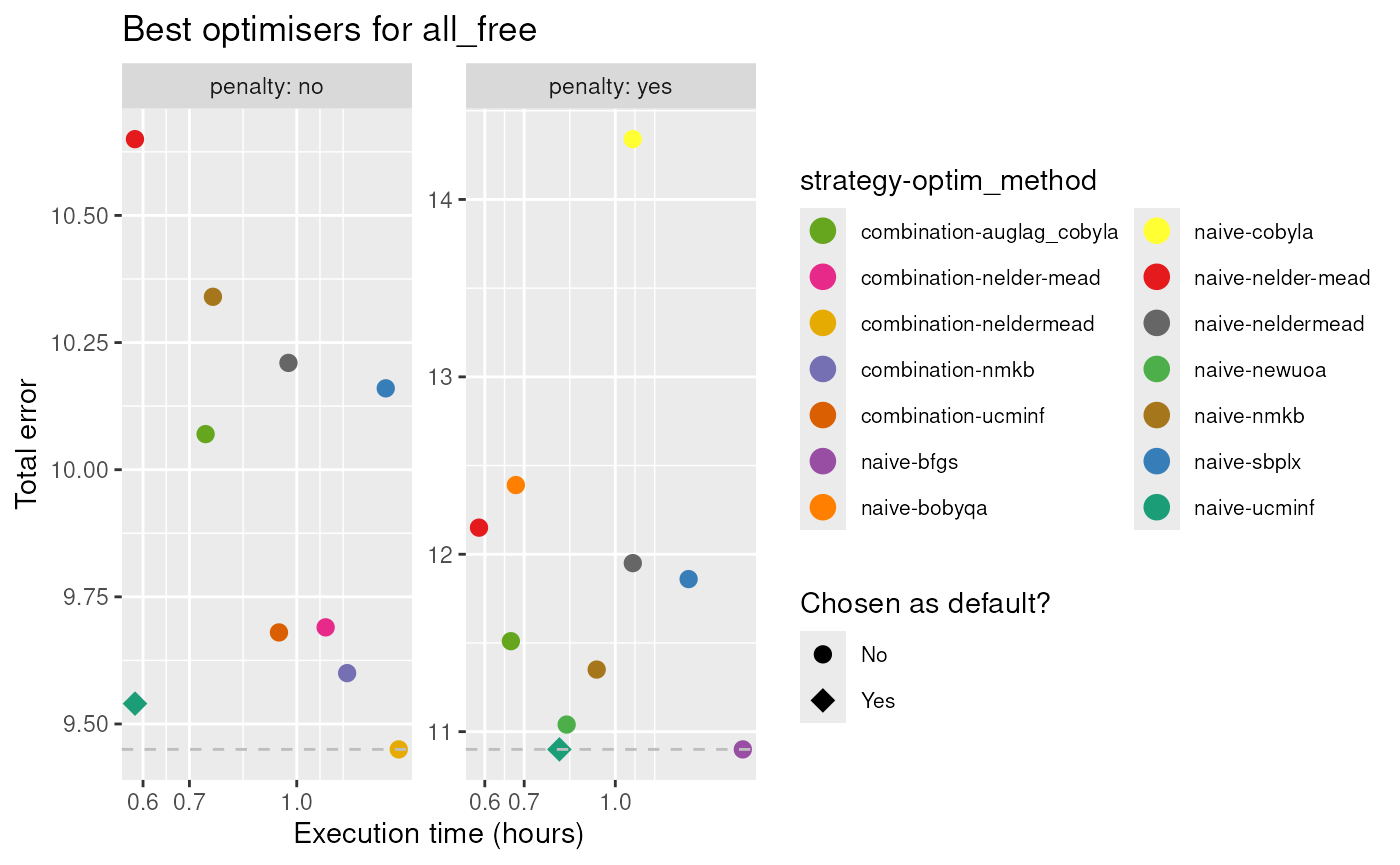
In total, we find that there is no clear choice for best, general optimiser/strategy combination.
For the defaults, we have chose the optimiser/strategy combination dependent on the method of parametrisation and the inclusion of penalty.
The following optimiser/strategy combinations acts as defaults for
the ?DiseasyImmunity class:
| method | penalty | strategy | optim_method |
|---|---|---|---|
| free_delta | no | naive | ucminf |
| free_delta | yes | naive | ucminf |
| free_gamma | no | naive | subplex |
| free_gamma | yes | naive | hjkb |
| all_free | no | naive | ucminf |
| all_free | yes | naive | ucminf |
However, as we see in the Per target results section below, the choice of optimiser/strategy can be improved when accounting for the specific target function.
Per target results
Here we dive deeper into the performance of the optimisers on a per target basis. As before, we present best performing optimisers for the given targets in an aggregated view.
We present the top 3 best optimiser/strategy combination for each method and penalty setting.
| penalty |
free_delta
|
free_gamma
|
all_free
|
||||||
|---|---|---|---|---|---|---|---|---|---|
| strategy | optimiser | value | strategy | optimiser | value | strategy | optimiser | value | |
| no | naive | ucminf | 0.00 | naive | ucminf | 0.00 | naive | ucminf | 0.00 |
| no | recursive | bobyqa | 0.00 | recursive | ucminf | 0.00 | naive | neldermead | 0.00 |
| no | recursive | ucminf | 0.00 | naive | neldermead | 0.00 | naive | bobyqa | 0.00 |
| yes | naive | ucminf | 0.37 | naive | hjkb | 0.31 | naive | anms | 0.18 |
| yes | naive | neldermead | 0.37 | recursive | hjkb | 0.31 | naive | auglag_slsqp | 0.19 |
| yes | recursive | bobyqa | 0.37 | naive | neldermead | 0.32 | naive | slsqp | 0.19 |
| auglag_lbfgs: auglag with SLSQP as local solver. | |||||||||
| penalty |
free_delta
|
free_gamma
|
all_free
|
||||||
|---|---|---|---|---|---|---|---|---|---|
| strategy | optimiser | value | strategy | optimiser | value | strategy | optimiser | value | |
| no | recursive | ucminf | 1.63 | recursive | subplex | 2.56 | recursive | neldermead | 1.24 |
| no | recursive | bobyqa | 1.63 | recursive | sbplx | 2.78 | naive | ucminf | 1.35 |
| no | recursive | bfgs | 1.63 | naive | subplex | 2.94 | naive | bobyqa | 1.35 |
| yes | naive | ucminf | 2.26 | recursive | pracmanm | 3.62 | combination | pracmanm | 1.53 |
| yes | recursive | ucminf | 2.26 | recursive | hjkb | 3.77 | combination | neldermead | 1.55 |
| yes | naive | bfgs | 2.26 | naive | hjkb | 3.94 | naive | pracmanm | 1.61 |
| penalty |
free_delta
|
free_gamma
|
all_free
|
||||||
|---|---|---|---|---|---|---|---|---|---|
| strategy | optimiser | value | strategy | optimiser | value | strategy | optimiser | value | |
| no | naive | ucminf | 12.83 | naive | auglag_lbfgs | 9.06 | naive | ucminf | 9.06 |
| no | naive | bobyqa | 12.83 | naive | uobyqa | 9.06 | naive | auglag_slsqp | 9.06 |
| no | naive | lbfgs | 12.83 | naive | lbfgs | 9.06 | combination | sbplx | 9.06 |
| yes | naive | ucminf | 13.16 | naive | subplex | 9.74 | naive | anms | 9.74 |
| yes | naive | spg | 13.16 | naive | pracmanm | 9.74 | combination | bfgs | 9.75 |
| yes | naive | bobyqa | 13.16 | naive | bfgs | 9.75 | naive | bfgs | 9.75 |
| auglag_lbfgs: auglag with LBFGS as local solver. | |||||||||
| auglag_lbfgs: auglag with SLSQP as local solver. | |||||||||