DiseasyModelRegression
Source:vignettes/articles/diseasy-model-regression.Rmd
diseasy-model-regression.Rmd
library(diseasy)
#> Loading required package: diseasystore
#>
#> Attaching package: 'diseasy'
#> The following object is masked from 'package:diseasystore':
#>
#>     diseasyoption
Introduction
In diseasy we bundle some simple regression model
templates and provide the tools to create custom regression model
templates.
Overview
These are structured as R6 classes that uses inheritance to simplify the creating of individual templates.
Structurally, R6 classes we provide are as follows:
| Module | Description |
|---|---|
?DiseasyModel |
All model templates initially inherit from this module (see
vignette("creating-a-model")). |
?DiseasyModelRegression |
Defines the structure of regression model templates (i.e. must
implement $fit_regression(),
$get_prediction(), and
$update_formula()). |
?DiseasyModelGLM |
Implements $fit_regression() and
$get_prediction() using stats::glm
|
?DiseasyModelBRM |
Implements $fit_regression() and
$get_prediction() using brms::brm
|
?DiseasyModelG0 |
Implements $update_formula() to create a constant
predictor model (from ?DiseasyModelGLM) |
?DiseasyModelG1 |
Implements $update_formula() to create a exponential
growth predictor model (from ?DiseasyModelGLM) |
?DiseasyModelB0 |
Implements $update_formula() to create a constant
predictor model (from ?DiseasyModelBRM) |
?DiseasyModelB1 |
Implements $update_formula() to create a exponential
growth predictor model (from ?DiseasyModelBRM) |
Examples
Here we show how to use the simple regression model templates in
diseasy.
The regression models are “duplicated” in the sense that there exist two similar models implemented in different statistical engines. The predictions from the models are very similar.
| Engine \ model | constant | exponential |
|---|---|---|
| glm | ?DiseasyModelG0 |
?DiseasyModelG1 |
| brms | ?DiseasyModelB0 |
?DiseasyModelB1 |
For the examples below, we therefore show the results from the GLM class of models only.
The data to model
As our example data, we will use the bundled example data
?DiseasystoreSeirExample.
# Configure a observables module with the example data and database
conn <- DBI::dbConnect(RSQLite::SQLite())

observables <- DiseasyObservables$new(
  diseasystore = DiseasystoreSeirExample,
  conn = conn
)
The data is stratified by age and covers a single infection wave. It contains two observables of interest for our example:
- n_positive: The observed subset of infected (65% of true infected with weekday variation in detection).
- n_admissions: The number of new hospital admissions due to infections (risk of hospitalisation dependent on age group).
When running the models, we should also define at what point in time
they should provide predictions for. This is done by setting the
last_queryable_date in the observables module:
last_queryable_date <- observables$ds$min_start_date + 60Lets first look at the data we have available:
observables$get_observation(
  observable = "n_positive",
  stratification = rlang::quos(age_group),
  start_date = observables$ds$min_start_date,
  end_date = observables$ds$max_end_date
) |>
  ggplot2::ggplot(ggplot2::aes(x = date, y = n_positive)) +
  ggplot2::geom_vline(
    xintercept = last_queryable_date,
    color = "black",
    linetype = "dashed"
  ) +
  ggplot2::geom_point(color = "seagreen") +
  ggplot2::labs(title = "Observed number of positive cases") +
  ggplot2::facet_grid(~ age_group)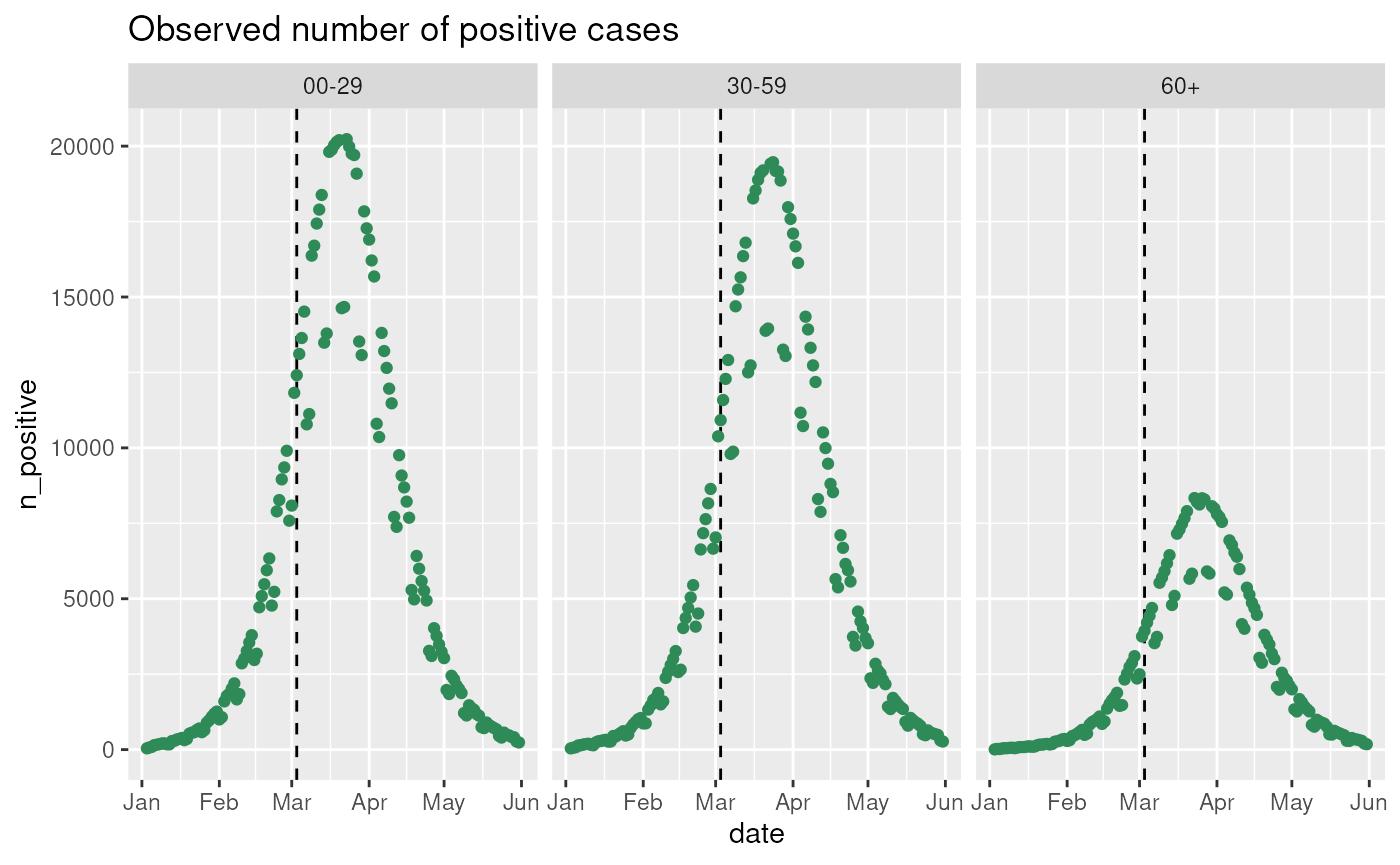
observables$get_observation(
  observable = "n_admission",
  stratification = rlang::quos(age_group),
  start_date = observables$ds$min_start_date,
  end_date = observables$ds$max_end_date
) |>
  ggplot2::ggplot(ggplot2::aes(x = date, y = n_admission)) +
  ggplot2::geom_vline(
    xintercept = last_queryable_date,
    color = "black",
    linetype = "dashed"
  ) +
  ggplot2::geom_point(color = "violetred3") +
  ggplot2::labs(title = "Number of admissions") +
  ggplot2::facet_grid(~ age_group)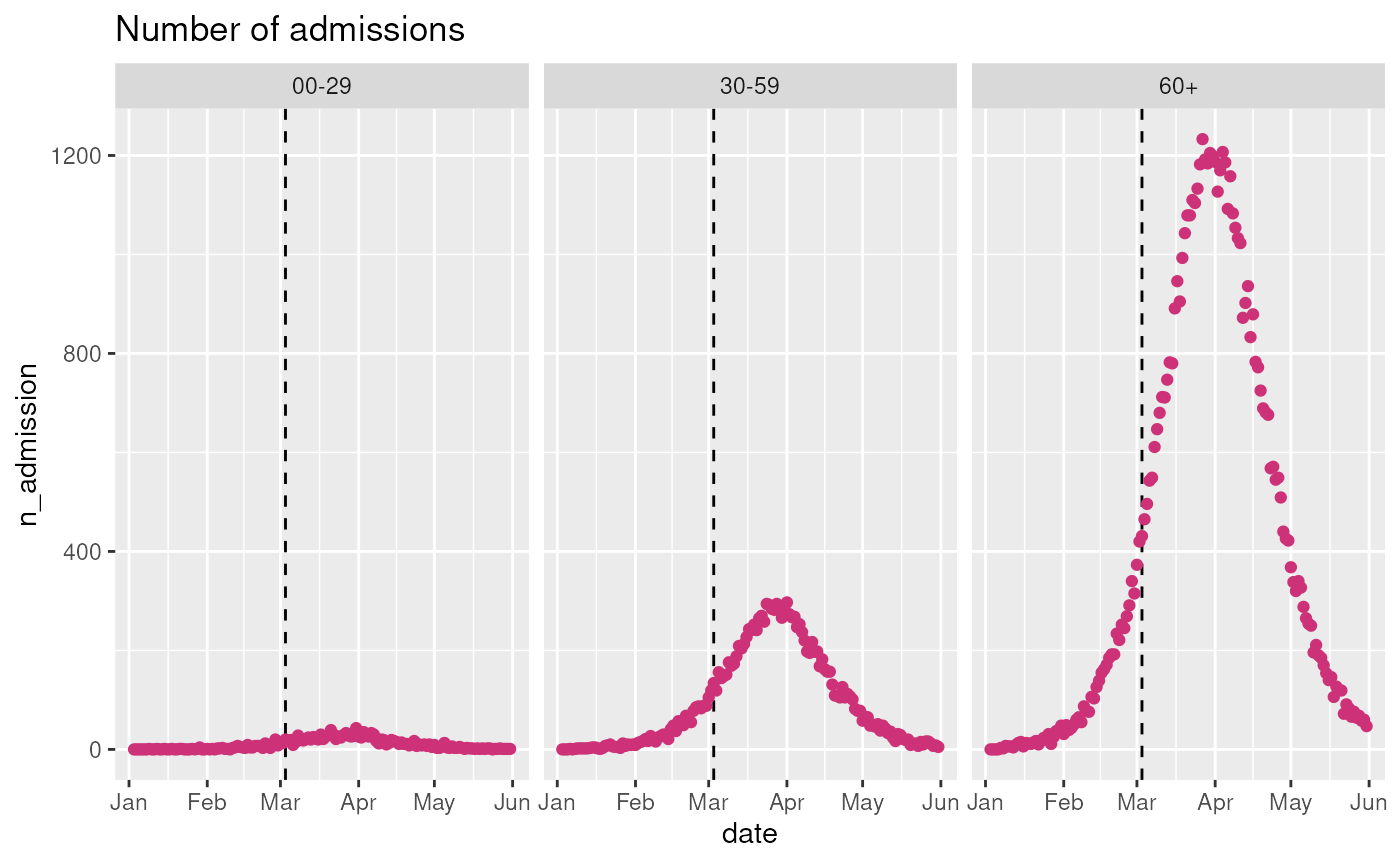
Applying the models to the data
The regressions models are special class of models which can directly model the data, and requires essentially no configuration.
Since the models are “duplicated” as described above, we here show only the results for the GLM family of models
observables$set_last_queryable_date(last_queryable_date)
model_1 <- DiseasyModelG0$new(observables = observables)
model_2 <- DiseasyModelG1$new(observables = observables)
The models are configured out-of-the-box and we can now retrieve model predictions for any observable:
model_1$get_results(
  observable = "n_positive",
  prediction_length = 30
)
#> # A tibble: 3,000 × 4
#>    date       n_positive realisation_id weight
#>    <date>          <dbl> <chr>           <dbl>
#>  1 2020-03-04     15427. 1                   1
#>  2 2020-03-05     13943. 1                   1
#>  3 2020-03-06     15493. 1                   1
#>  4 2020-03-07     15436. 1                   1
#>  5 2020-03-08     14616. 1                   1
#>  6 2020-03-09     12907. 1                   1
#>  7 2020-03-10     13419. 1                   1
#>  8 2020-03-11     13971. 1                   1
#>  9 2020-03-12     14230. 1                   1
#> 10 2020-03-13     16589. 1                   1
#> # ℹ 2,990 more rows
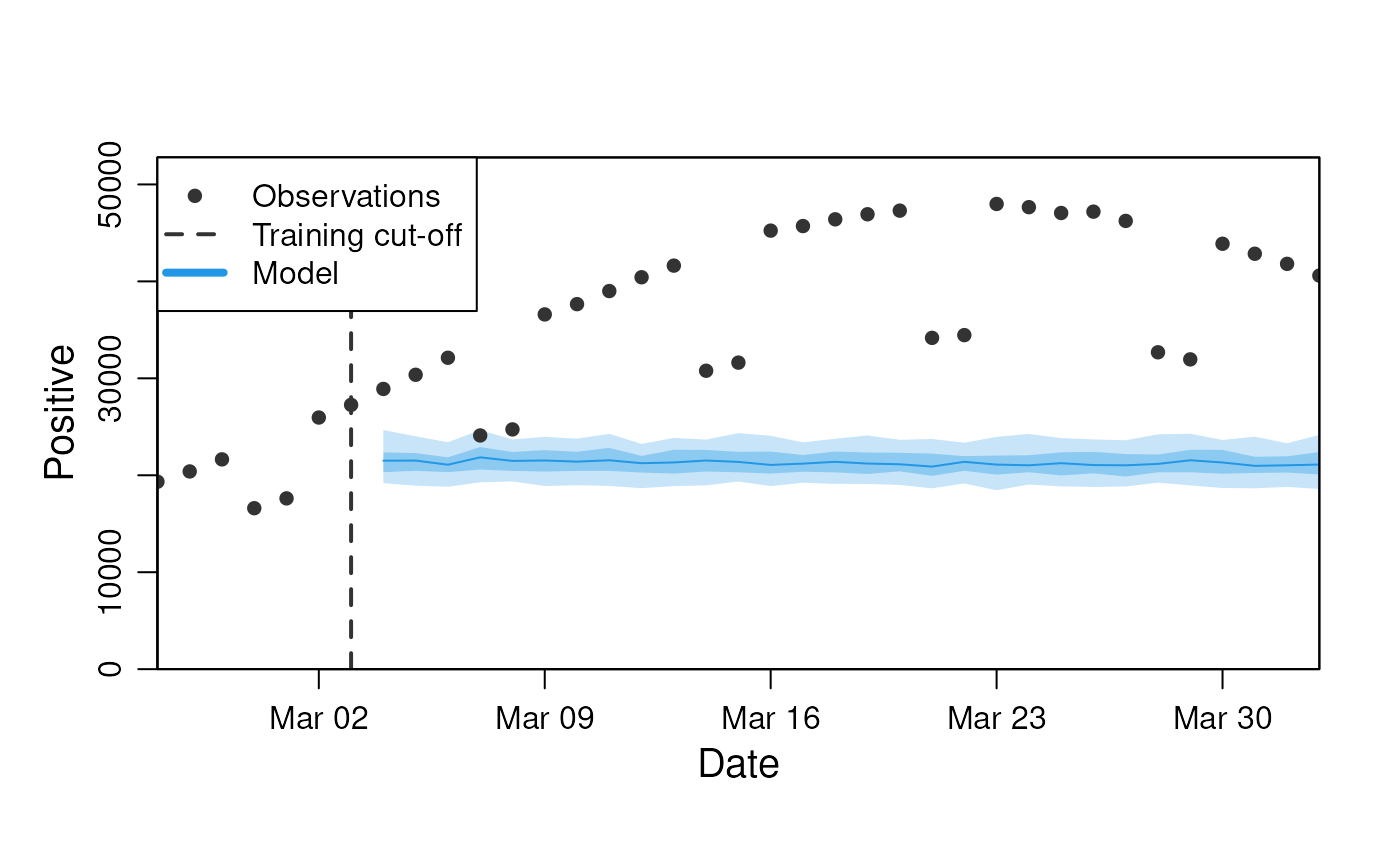
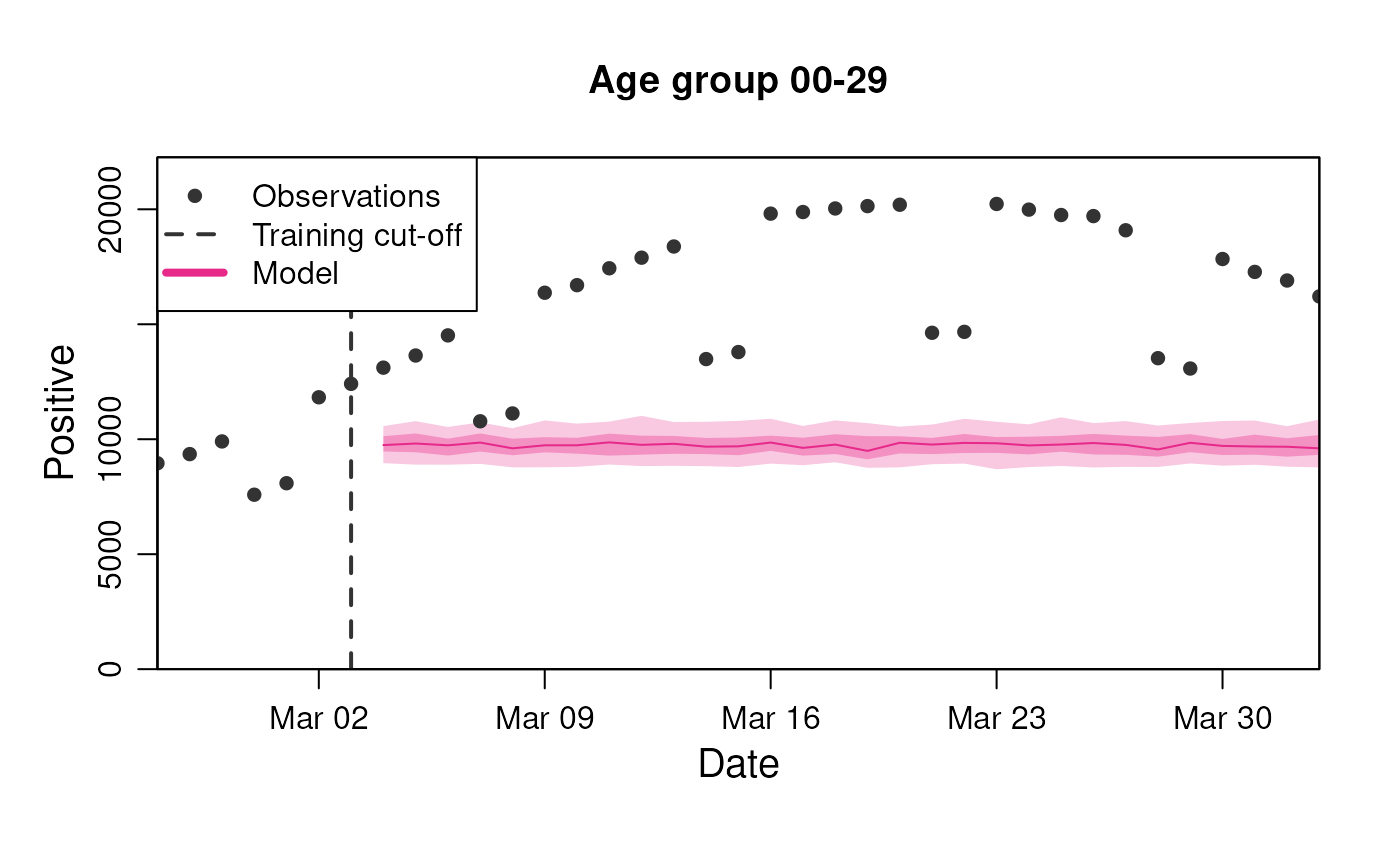
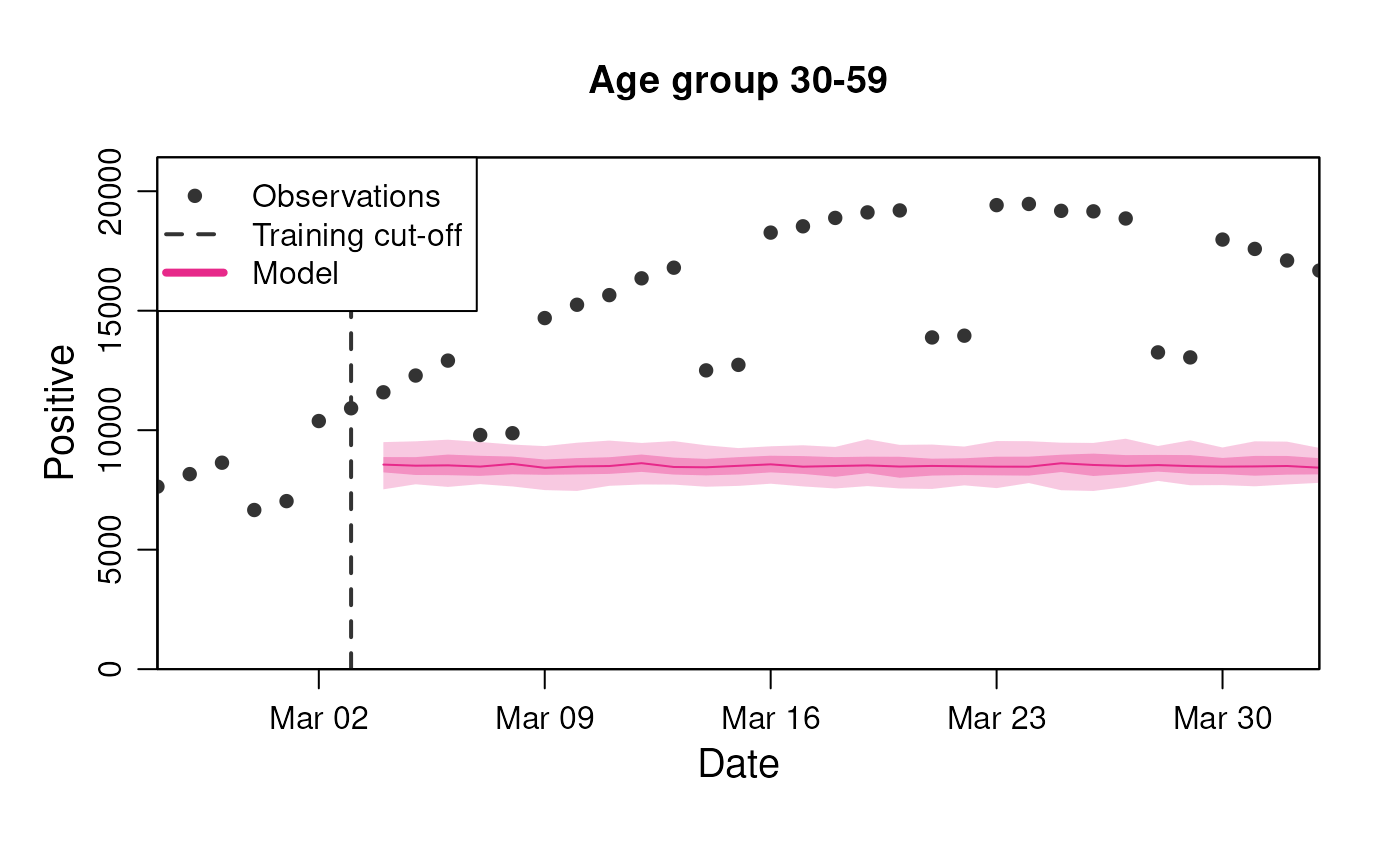
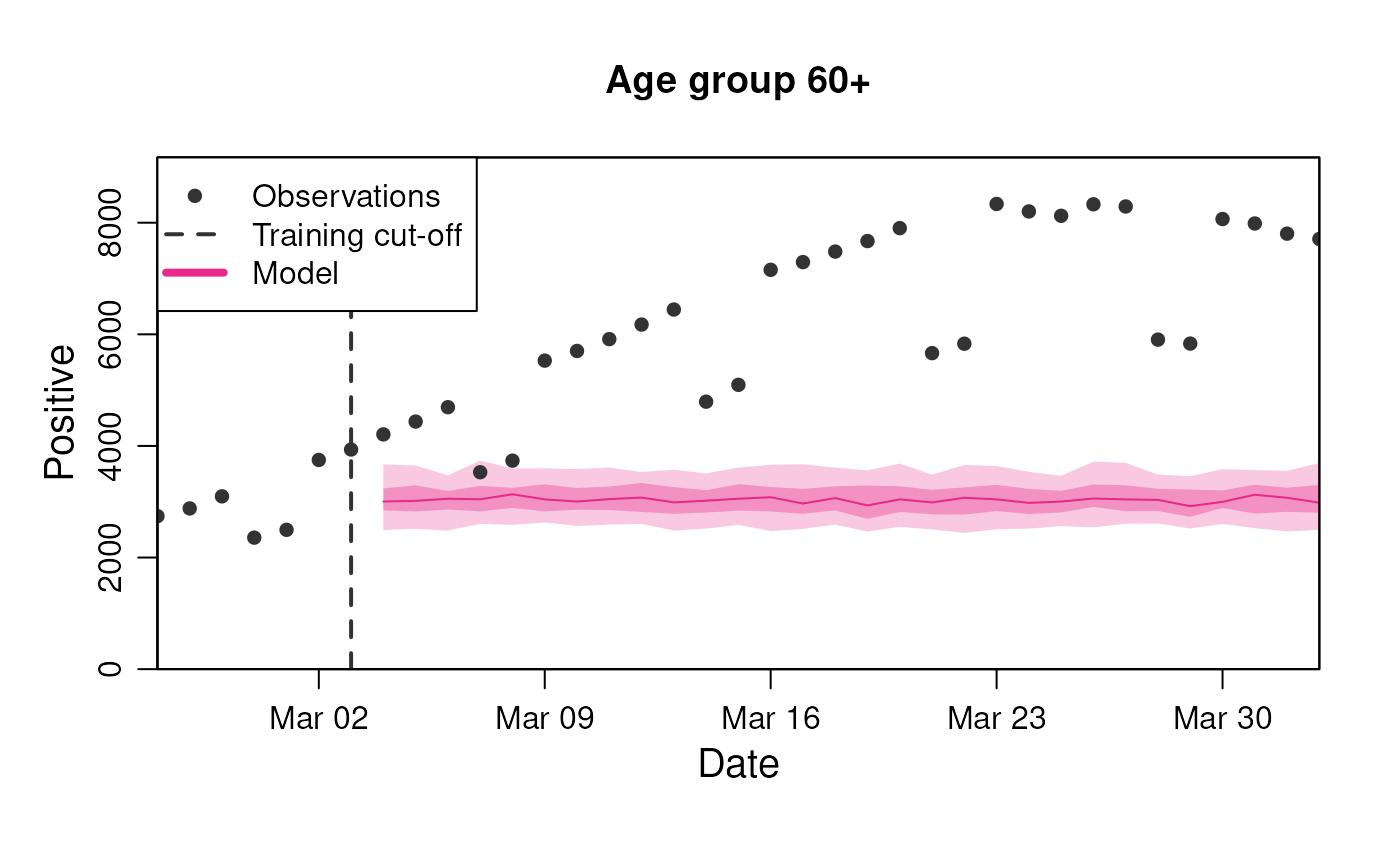
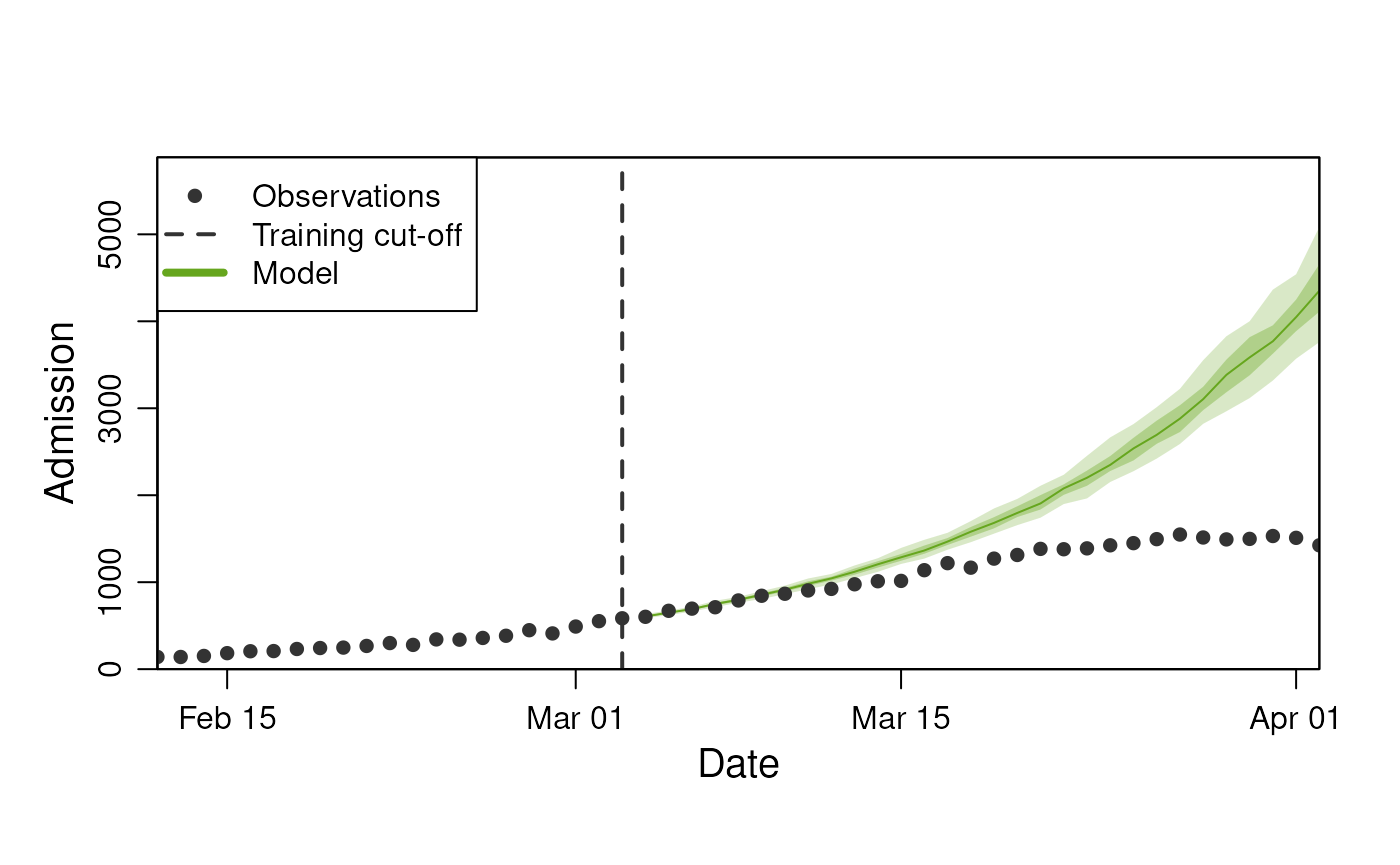
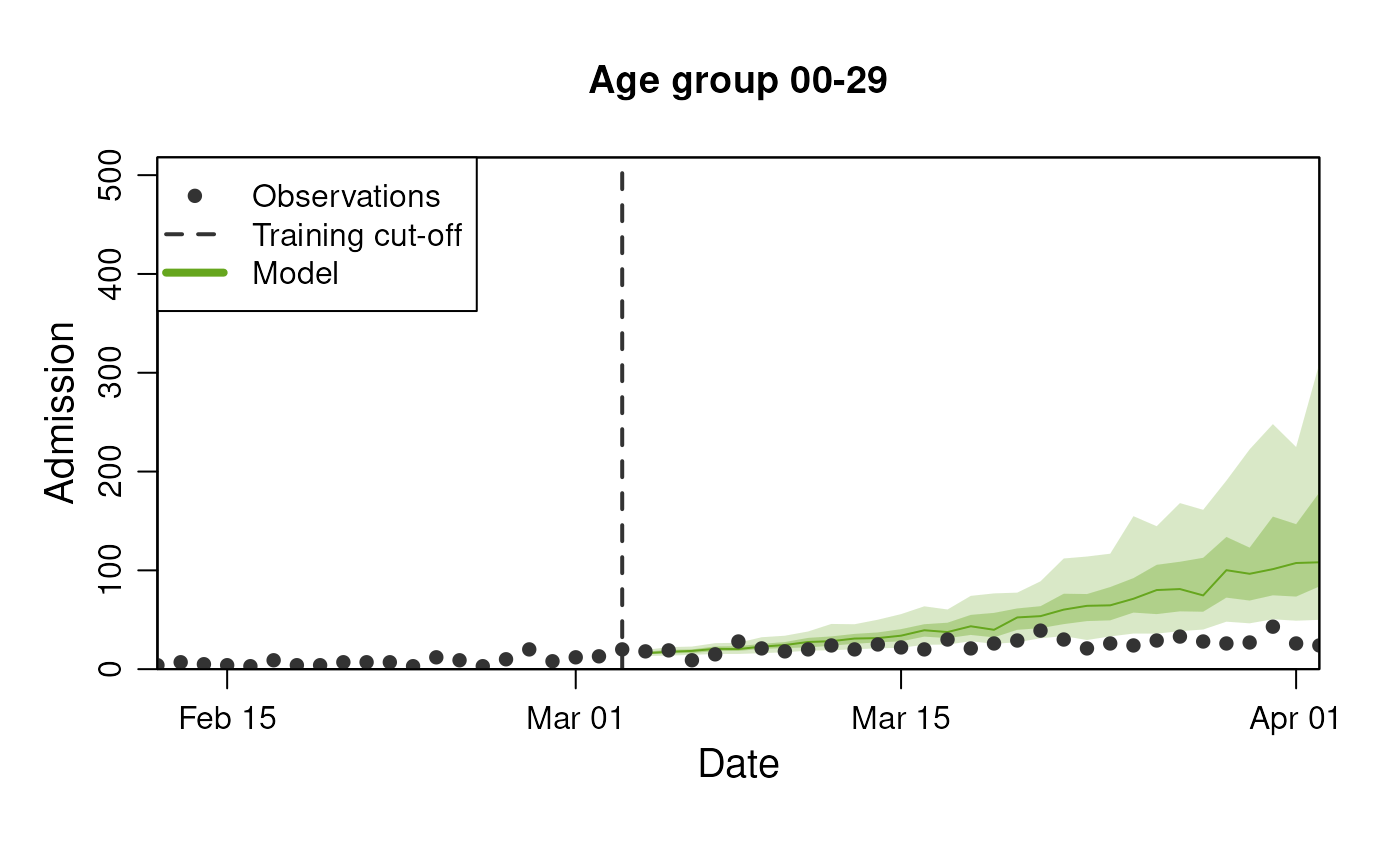
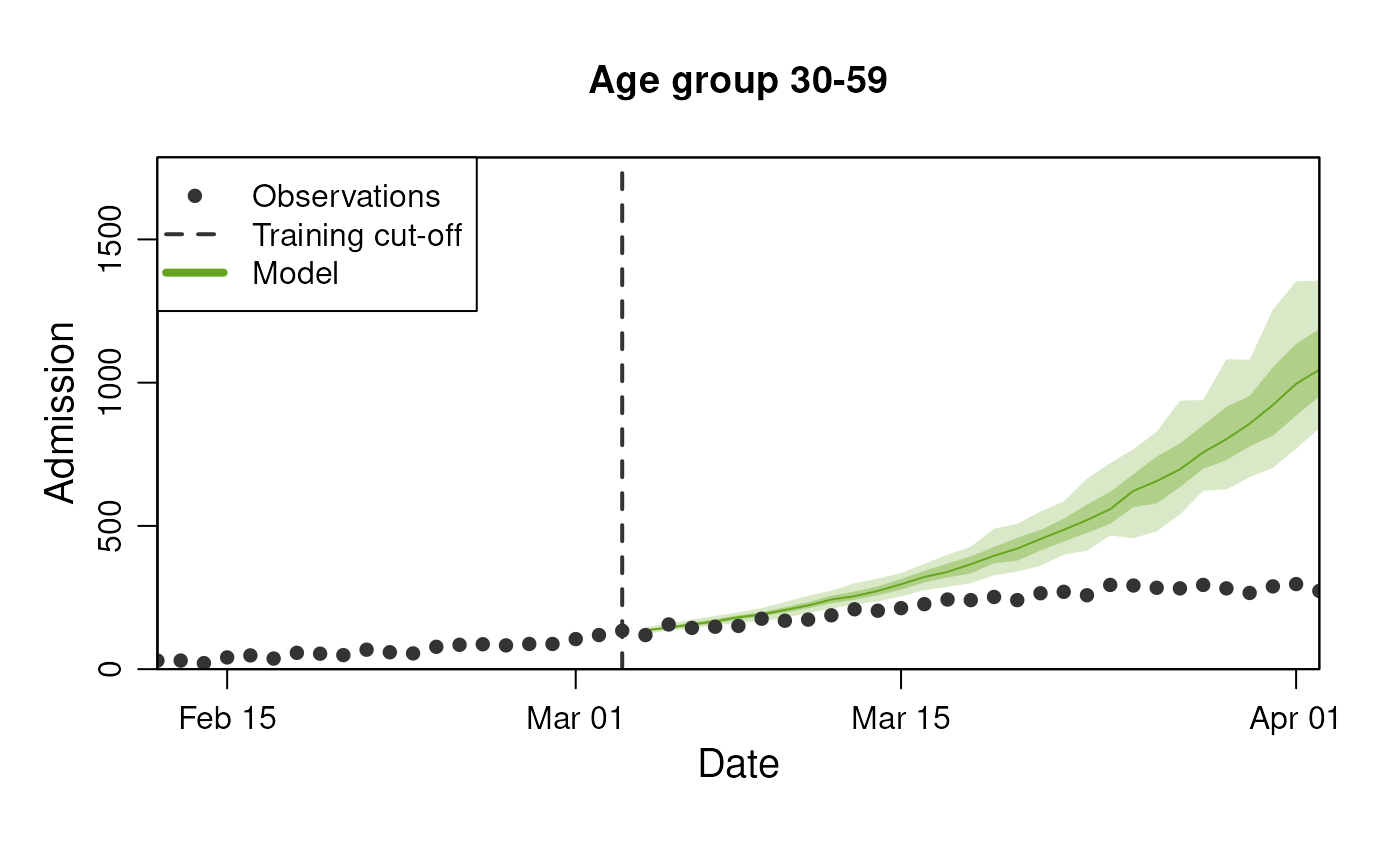
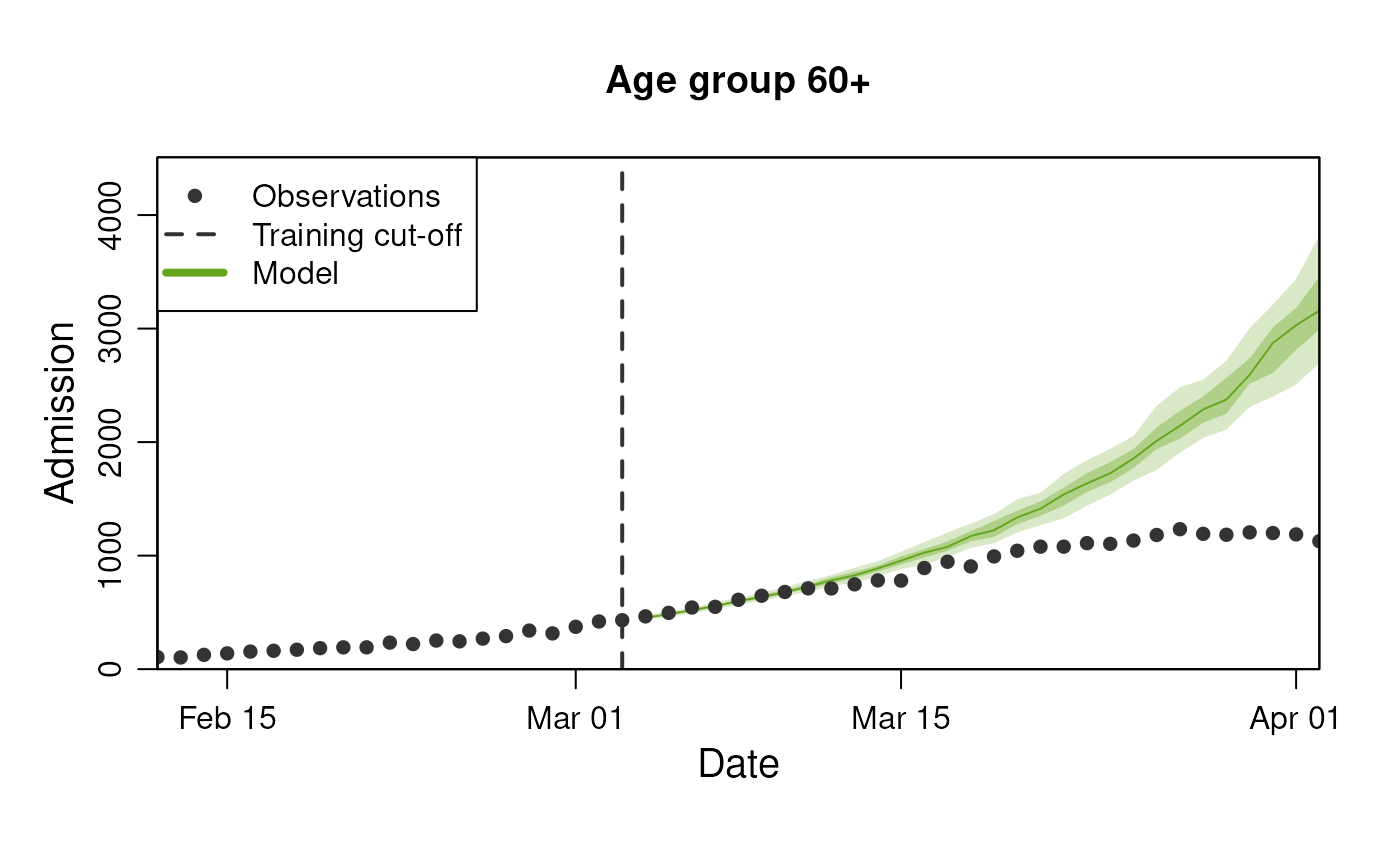
To visualise these predictions, we can use the standard
plot() method where we supply the observable to predict and
the number of days to predict into the future, as well as any
stratification supported by the diseasystore.